
The Kyushu region, situated in southern Japan, comprises seven prefectures.
The name Kyushu, meaning ‘nine provinces’, no longer accurately reflects the region’s current state, stemming from the major reforms to Japan’s social structure in the 1870s.
In other words, even 150 years after these reforms, the historical name continues to be used.
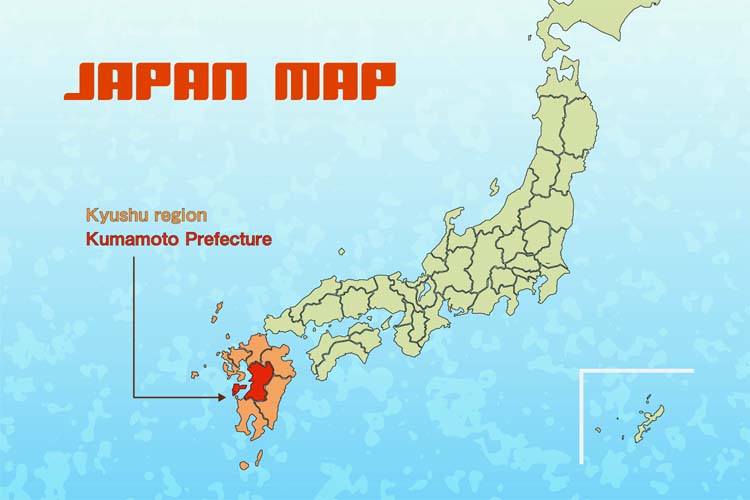
Kumamoto Prefecture, situated in the central part of modern-day Kyushu, was formerly known as Higo Province.
The ‘Hi / 肥’ in ‘Higo’ signifies ‘fertile soil’, though originally a different meaning of ‘Hi’ was employed.
That meaning was the word ‘fire / Hi / 火’.
Kumamoto Prefecture / Higo Province was known as the ‘Land of Fire / 火の国’.
Why is it called the ‘Land of Fire’?
It is because Mount Aso is located in Kumamoto Prefecture.
Mount Aso is one of Japan’s largest active volcanoes, and at its centre lies one of the world’s largest calderas, measuring approximately 17 kilometres east-west, 25 kilometres north-south, and covering an area of about 350 square kilometres.
Its original form is said to have been established millions of years ago, stabilising into its present shape hundreds of thousands of years ago, yet volcanic activity continues to this day.
Evidence suggests that ash from past major eruptions reached as far as Hokkaido, over 2,000 kilometres away, where traces have been confirmed.
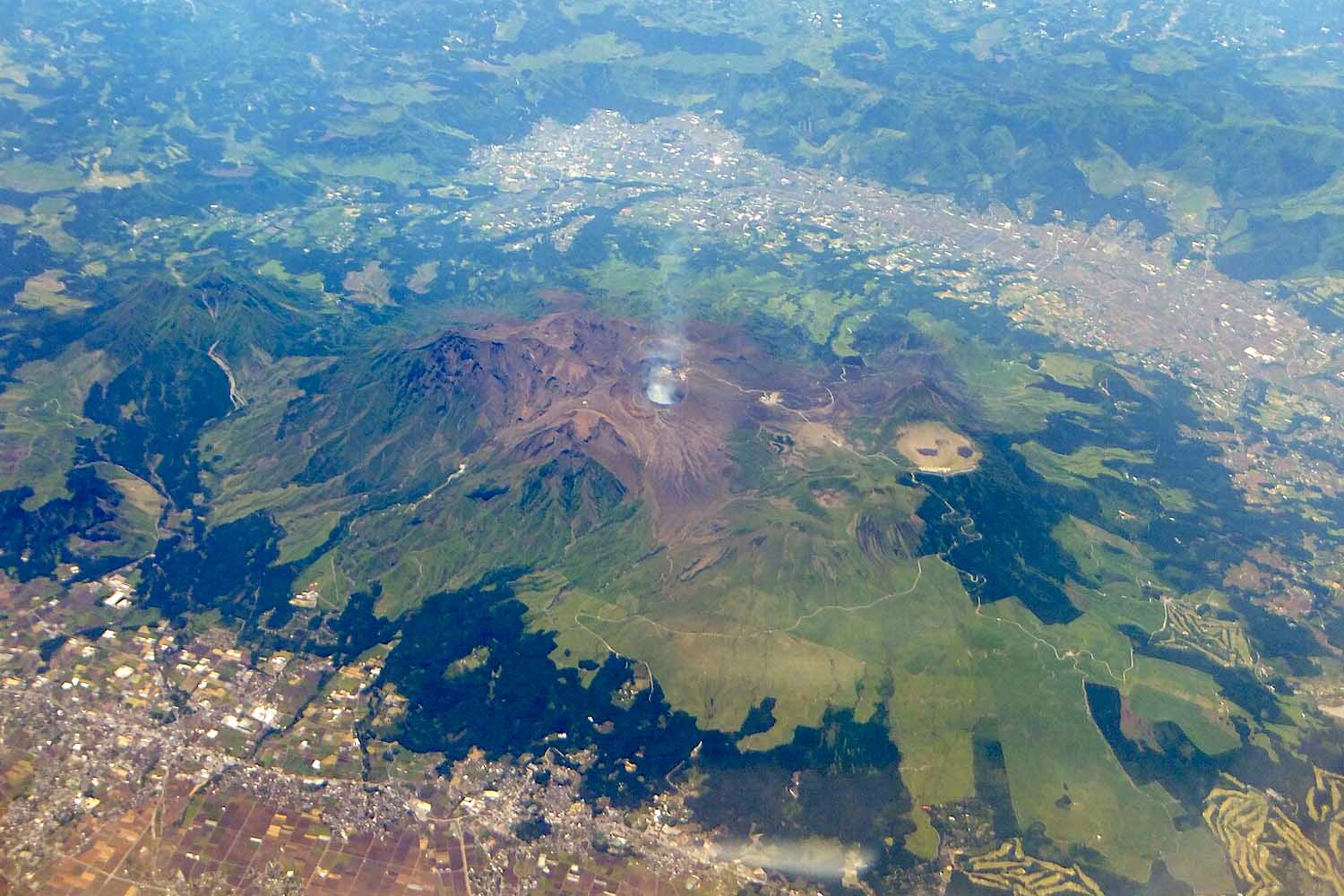
Mount Aso CC3.0 Wikipedia_Sonata
Currently, the entire area surrounding Mount Aso has been designated a Geopark/National Park, making it a tourist destination where visitors can enjoy magnificent natural landscapes.
However, it is said that should Mount Aso become truly enraged, it could inflict devastating damage upon the western half of Japan. One can only hope it remains in a good mood forever. (^_^;)
Now then, the following image is an aerial photograph of Mount Aso. Can you see the large gorge on the western side of the Aso caldera?
It is now an essential route for accessing Aso from Kumamoto City… but in fact, this is evidence that approximately 73,000 years ago, this section of the caldera breached and collapsed.
If it had merely collapsed, the elevation would have dropped somewhat, but this section has completely vanished, leaving a distinct valley… This means something immense passed through here. What on earth could that immense something have been…?
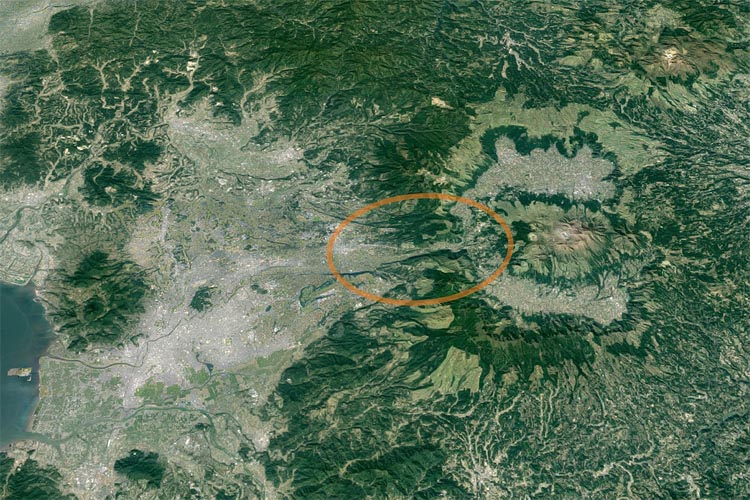
The answer is “water”. Traces of an immense volume of water overflowing, accompanied by the collapse of the foothills, formed the canyon.
Until approximately 73,000 years ago, Mount Aso was also a vast caldera lake brimming with water. The western side of Aso, or rather the area around present-day Kumamoto City, could be described as a plain formed on the former floodplain of that great deluge.
At the northern archaeological site of the Aso caldera, buried artefacts resembling paddles (used for rowing boats) from that era have been discovered, indicating that a significant lake persisted in this area relatively recently. (Though ‘recently’ here means around 8,000 years ago…) (^_^;)
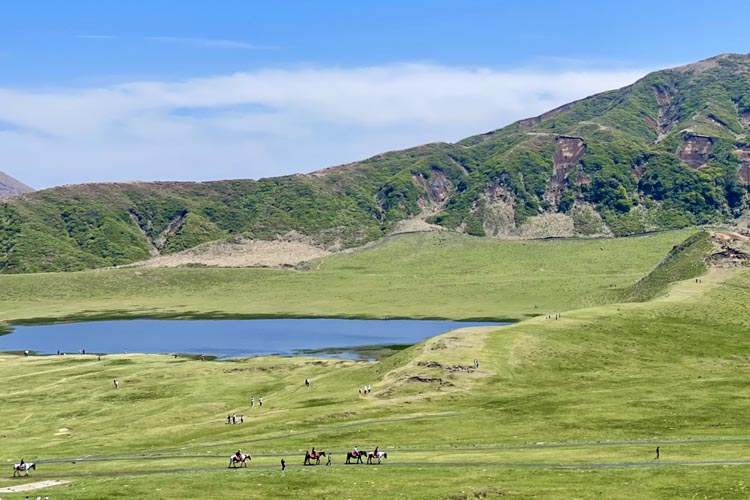
A remnant of this era can be seen in the western caldera at Kusasenrigahama.
Located at an altitude of 1,130 metres, the combination of grassland and a pond reflecting like a mirror makes this a must-see spot.
The history of Mount Aso is truly one of dynamic activity, yet at its foothills lies a serene forest and a mysterious shrine standing within it.
Its name is Kamishikimi Kumano imasu(za) Shrine.
Though a very long name, ‘Kamishikimi’ refers to the district where this shrine is located, while ‘Kumano imasu(za)’ signifies the place where the Kumano deities reside.
Alongside the road passing through the tranquil village, a flight of twenty steps ascends to where the “First Torii Gate” stands quietly.
After joining your hands in prayer and greeting the deity, climbing the steps of the approach leading to the main hall, you will soon find yourself enveloped in a scene of profound mystery, surrounded by dense, deep green foliage.
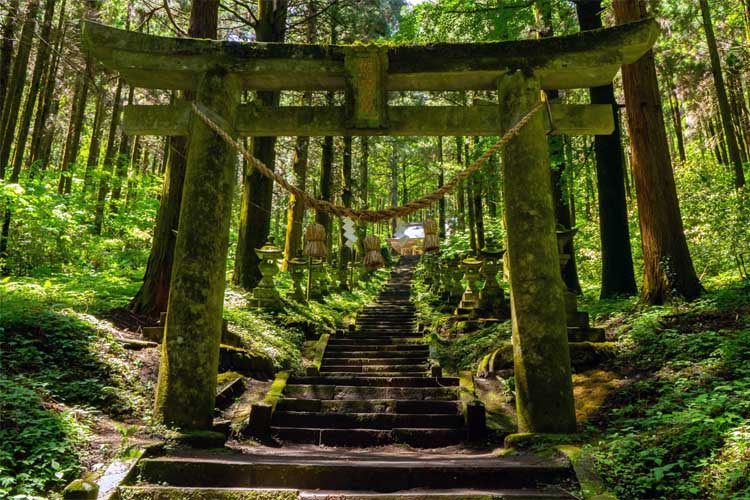
The eerie presence of some 100 stone lanterns lining both sides of the approach, stretching all the way to the distant entrance of the worship hall, may heighten the sense of a different passage of time, distinct from the human world.
The atmosphere created by the 260 steps leading to the worship hall, flanked by a stand of cedar trees that seem to select those who may enter, may instil a slight sense of solemnity in the worshipper.
Feeling the forest’s chill in the sweat beading on your brow, you press onward. Just as weariness sets in, the inner torii gate leading to the worship hall finally comes into view.
Looking back along the approach path you’ve climbed, enveloped in the scent of moss, vines, and wood, you may find yourself in a solemn mood, contemplating the path you’ve travelled.
Passing through the inner torii gate, one last effort brings you at last to the worship hall.
It is a tranquil shrine, standing alone in the forest, and also the main hall. Yet, observing its construction, one cannot help but feel it connects to the ancient faith that revered and worshipped the entire Aso mountain range as a deity.
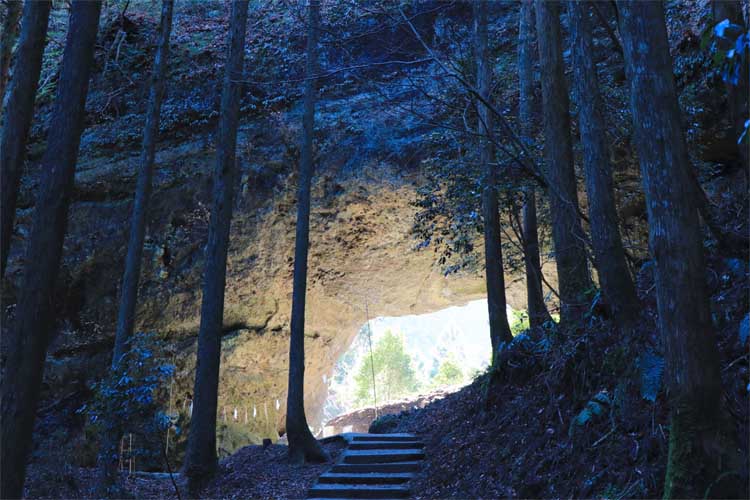
Climbing further along the mountain path beside the worship hall, leaning on a walking stick, one eventually comes upon the enormous rock cavity known as ‘Uge-to-iwa(Rock)’, measuring 10 metres in width and height. It is a ‘wind cave’, a passageway for the mountain winds, where the high-speed gusts blowing through leave a striking impression.
An ancient legend tells of a divine messenger kicking open this rock cavity within the mountain. Given its position directly along the line connecting the shrine entrance to the worship hall, it is thought this rock cavity was also an object of worship.
Kamishikimi Kumano Shrine
Here, there is neither a large shrine office nor a treasure hall, nor even roadside tea shops. Yet the breath of natural worship, quietly sustained since ancient times, still lives on…
Among shrines and temples that have gained fame, there are numerous instances where an excessive influx of visitors has led to problems such as litter and damage.
Should Kamishikimi Kumano Shrine become widely known and see an increase in visitors, it cannot be ruled out that it might one day face similar troubles.
While shrines exist to be visited by people, they are also ‘special’ places, sacred domains.
Should you ever have the opportunity to pay your respects, please remember this, even just a little, and approach your visit with a humble heart. For the sake of both people and nature.
Do so, and the majestic Land of Fire and its mysterious shrine will welcome you warmly…