
This article will explore the Japanese people and their language, which are often described by foreigners as “not speaking clearly”.
Whilst I endeavour to write carefully, there remains a risk of misunderstanding arising from imperfections in translation or differences in how the text is interpreted. I would be grateful if you could interpret it as favourably as possible.
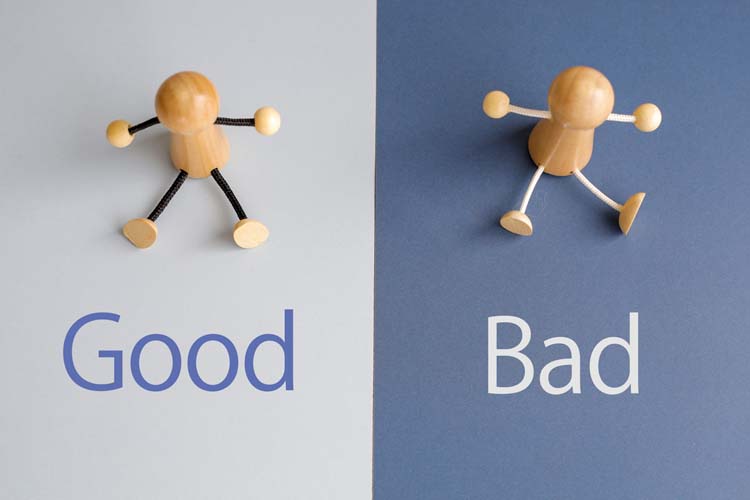
In Japanese, there is the word ‘良い / Ee’*.
Its meaning is ‘Good’ in English.
There is also the word ‘悪い / Warui’.
Its meaning is ‘Bad’ in English.
Of course, in Japan too, it is used to mean ‘Ee: Good’ and ‘Warui: Bad’.
However, in everyday conversation within Japan, these two words are sometimes used in ways quite different from their original meanings.
You may not encounter this much during short trips to Japan, but as you interact more with Japanese people, you may find yourself in such situations more often.
‘Ee: Good’ and ‘Warui: Bad’ – their usage can differ considerably from their literal meanings… and sometimes even seem completely opposite. Please take care to avoid confusion or causing misunderstandings when encountering this aspect of the Japanese language.
(* Strictly speaking it is ‘Yoi’, but in spoken language ‘Ee’ is often used.)
Suppose you owned a house in Japan and lived there.
Suppose a Japanese friend visited your home. To entertain your friend, you served a home-cooked dinner.
As you all ate and chatted, enjoying a pleasant time, you kept bringing dishes to the table. At that moment, your Japanese friend said, ‘It’s Ee.’

‘Ee?’ Thinking it meant “Good”, you assumed your friend was delighted with the abundance of food and proceeded to bring the next dish to the table. Instead, your friend looked troubled.
Why might this be?
In fact, your Japanese friend wasn’t saying the large meal was “Ee / Good”. They were trying to convey that they were already full and didn’t need the next dish.
Why use the word ‘Ee / Good’ instead of simply saying ‘Not needed’?
The ‘Ee’ used by Japanese people in this context reflects the meaning of ‘agreeing to forfeit the right to receive the next meal’. It could also be interpreted as ‘I am fine without the next meal’.
If something is not needed, one could simply say ‘It is not needed.’ So why use such a roundabout expression? It is a uniquely Japanese way of phrasing things, wrapped in a delicate manner.
As you know, Japan is an island nation with a near-single-ethnicity structure, influencing a sense of a “closed society” and a “society where people are considerate of each other”. Consequently, even in conversation, people try to avoid conflict as much as possible.
In Japan, when offered an unwanted gift, the closer the relationship with the giver, the more one should avoid saying “I don’t want it” directly.
Suppose you give a birthday present to a Japanese friend.
Your Japanese friend says with a pleased expression:
‘Thanks! Warui-ne (Bad)!’
Why “Bad” when they’re saying “Thanks!” and seem pleased? You might be confused.
If they sometimes omit the “Thanks” part and just reply with “Bad”, you might feel indignant, thinking, “I went to the trouble of giving them a present…”
But in this case, “Warui” doesn’t mean “Bad”…
In this situation, what your friend wanted to say after ‘Thanks!’ was essentially, ‘I’m sorry for making you go to the trouble’ or ‘I’m sorry for causing you the inconvenience’.
The word ‘Warui’ was used to express their feeling of regret for the expense or effort they had incurred. It absolutely was not meant to criticise the gift you gave them.
Well, Japanese really is rather roundabout and troublesome, isn’t it… (^_^;)
In this way, among the Japanese, a mindset that prioritises the inner world and avoids conflict between individuals tends to prevail. Consequently, their choice of words often appears somewhat opaque to those from overseas.
Japanese people tend to feel quite uncomfortable with direct attitudes or expressions, perceiving them as socially ill-mannered behaviour.

(The wrapping paper from received presents is often carefully stored away for reuse at a later date.)
In an old European film I once saw, there was a scene where the protagonist tore open the wrapping paper with a loud crackling sound and opened the box right in front of the sender.
I was astonished at the time. In Japan, the act of dismantling a gift box noisily in front of the sender is considered discourteous.
In Japan, if opening it on the spot after expressing thanks, one does so quietly and carefully. Alternatively, it is considered polite to take it home, examine the contents, and then formally convey one’s gratitude and delight.
After watching the film, I looked into it and was surprised again to learn that in Western countries, opening it dramatically on the spot has become established as a gesture to convey one’s joy to the giver.
Such is the difference in social conventions between countries.

In recent years, Japanese culture has become considerably Westernised, leading to a noticeable trend of prioritising personal assertions and clear expressions of intent over internal harmony and mutual accommodation.
Nevertheless, customs rooted in the Japanese character, such as some of the Japanese language examples introduced today, remain deeply ingrained. These represent rationality within Japanese culture, yet may appear irrational in international exchanges. Japan is the sum total of all these elements.
I do hope that when you have the opportunity to visit Japan, you will not be bewildered by the Japanese language.