
I previously wrote an article about mermaids in Japan.
Legends of mermaids exist in various countries and cultures around the world, including the Little Mermaid in Copenhagen, Denmark.

Why do distant countries have similar mythical creatures?
Indeed, why do mythical creatures—entities not particularly necessary for society and distant from everyday life—exist in the cultures of countries across the globe?
It is likely a manifestation of the inexplicable impulses and anxieties within the human heart. It may well reflect a sense of awe towards nature.
Wherever one lives on Earth, whatever culture one inhabits, the fundamental relationship between humans and nature remains essentially the same. Consequently, the ideas born from it may well be similar.
And as human cultures develop and regions interact, cultural influx occurs, with elements from other countries’ cultures assimilating into those already present within the nation.
This manifests in language, tools, ways of life, and is reflected even in legends such as those of mythical creatures.
Now then, the Japanese ‘Yōkai / mythical creatures’ I shall introduce today are selected from those recounted throughout Japan’s roughly 2000-year history, aiming to feature the most distinctive examples possible.
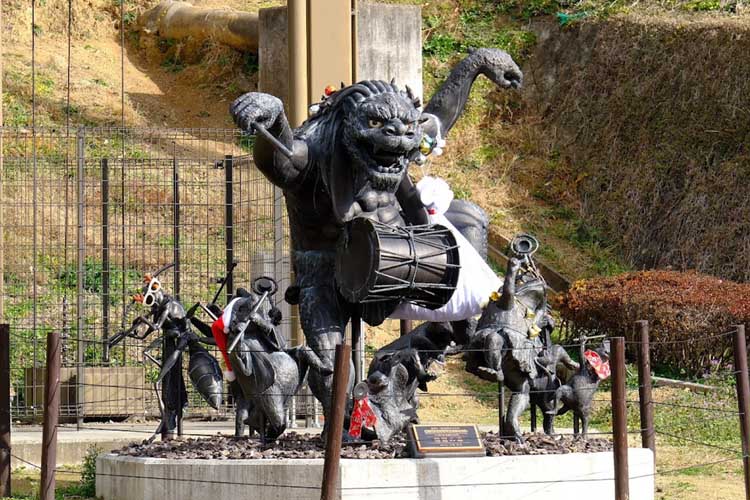
I had assumed these were uniquely Japanese mythical creatures, but upon investigation, I discovered some similar beings exist in other countries too.
Do similar mythical creatures exist in your country?
Rokuro-Kubi (long-necked woman)
These are mythical creatures, true to their name. They appear indistinguishable from ordinary human women during the day, revealing their true form only at night in deserted places. They frequently feature in legends dating back roughly 200 to 300 years.
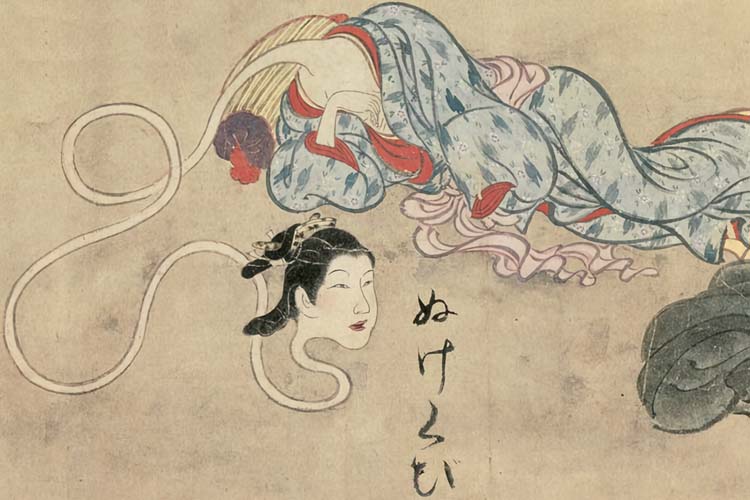
There appear to be two variations: one where the neck extends from tens of centimetres to several metres, and another where the neck detaches from the torso and floats in the air.
Despite their grotesque appearance, they are said to merely startle humans rather than kill them.
Being a prominent figure among Japanese Yōkai, they almost invariably featured in old horror films.
Similar creatures are said to exist in China, Southeast Asia, and South America.
Miage-Nyudō (A monk so tall one must look up to see him)
It is said that whilst walking along dimly lit mountain paths, he suddenly appears ahead, standing as if to block the way. At first, one might think he is a travelling monk or something similar and approach him, only to realise he has grown to be several metres, or even tens of metres tall…
(It is said he does not become a giant, but merely grows incredibly tall.)
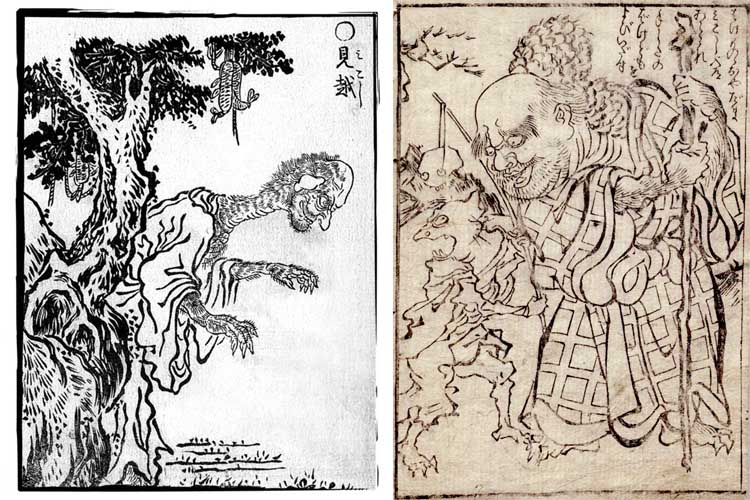
Being so tall, if you crane your neck too much and fall backwards, he’ll pounce on you, making him a rather dangerous spirit.
However, if you remain calm and declare loudly, “I’ve seen through you!”, he’ll vanish without doing anything…
What on earth does he come out for…? (^_^;)
Nurikabe (plastered wall)
A Yōkai akin to Miage-Nyudō’s workmate. They might even be related. It is said they too suddenly appear, blocking dark night paths.
The common Japanese image depicts a figure with only eyes and limbs attached to an earthen wall about 100 sq ft in area. However, some theories suggest the original form resembled an animal. Another theory posits it is a ‘Japanese raccoon dog’ in disguise.

Its mobility is virtually zero; it’s a Yōkai that seems to have allocated all its points to defence, accepting no means of breakthrough whatsoever. However, strangely enough, it is said that if you slip your hand into its narrow crotch, it vanishes and flees.
Why on earth are Japanese Yōkai such peculiar creatures?
Azuki-arai (Red Bean Washer)
This is yet another peculiar spirit. When venturing into the mountains for logging or gathering wild vegetables, one might hear the sound of red beans being rubbed and washed in a sieve, drifting from the direction of a stream.
“Who on earth would be washing beans in such a deserted place?” one might wonder, searching but finding no one. “Was it just my imagination?” one thinks, about to leave, when the sound of beans being washed resounds once more. Sometimes, the sound of an old man laughing can be heard too…
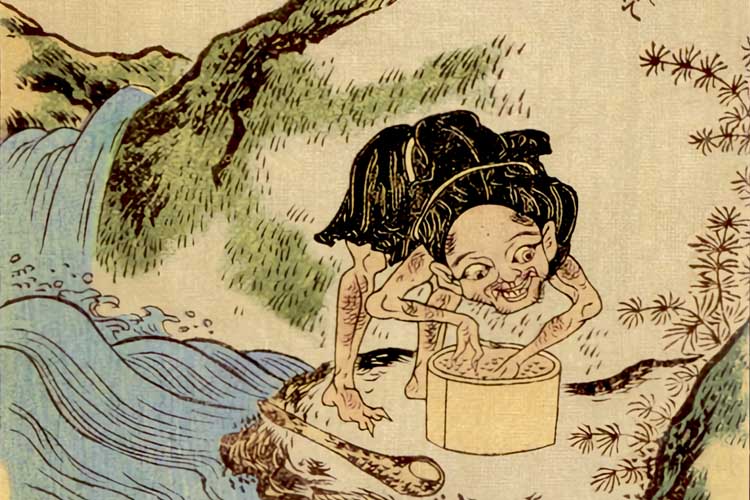
It never attacks. …But, on rare occasions, you might hear singing like this… “Wash the beans, or take a person and eat them♪”
Yet, it still doesn’t attack…
Is it really a Yōkai? Or is it just a hermit old man living in the mountains? (^_^;)
※ In Japan, red beans have been used for food since ancient times.
Turbo Granny
This isn’t a historically passed-down Yōkai, but rather a modern one. What you might call an urban legend.
Since turbochargers began appearing in mass-produced cars in Japan around the late 1970s, you could say this Yōkai was born in that era. Among Yōkai, she’s a youngster. Though she is an old woman…
Late at night, driving along the motorway, you suddenly sense a strange presence approaching from behind… You check the rear-view mirror, but nothing is reflected there.
At that very moment, an old woman, impossible to tell if she’s 80 or 90, overtakes your car with a running style that would put Usain Bolt to shame. At 100 km/h? 200 km/h? Barefoot, no less. They say she flashes a smile in your direction as she dashes past.
This Yōkai doesn’t attack either, but drivers so startled by the sight have been known to lose control, leading to accidents.
A turbocharger and an old lady. This utterly mismatched pairing makes for a modern-day supernatural being that’s just too amusing.
Another similar modern supernatural being, set on the night-time motorway, is the ‘Headless Rider’. It likely draws inspiration from the Irish folklore figure ‘Dullahan’ or the American legend ‘Sleepy Hollow’.
Humans have a peculiar tendency to avoid things that frighten them, yet for some reason they show interest in the terror described only in stories, even seeking to enjoy it.

Such complex and mysterious emotions unique to humans are likely universal across all nations. Perhaps this psychological backdrop is why similar tales emerge in various countries…
I’m personally finding this article quite enjoyable to write, so I think I’ll continue it once more. My apologies to those who find Yōkai topics uninteresting… m(__)m