Japan’s constitution guarantees ‘freedom of religion’ and there are many different religions in the country.
Buddhism has the largest proportion of adherents, but only a limited number of dedicated believers, and most follow it loosely as a spiritual stronghold.
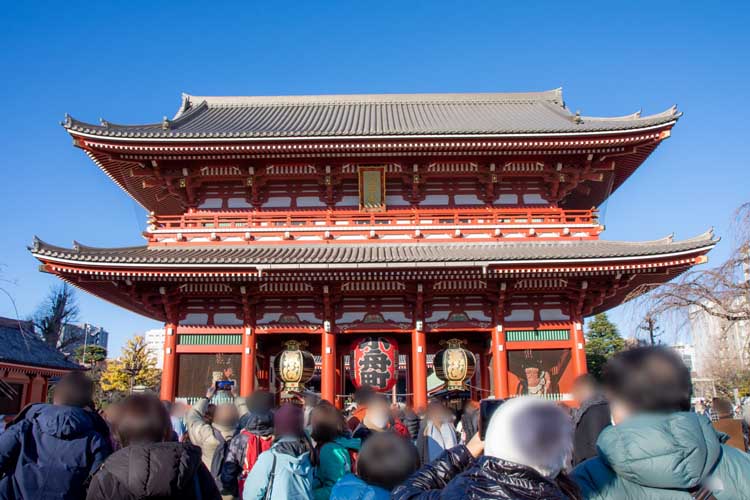
This loose religious belief of the Japanese may possibly be attributed to Shintoism, a uniquely Japanese religion.
Japanese Shinto emphasises flexibility, as it is a nature and ancestor worship that was built up by integrating the beliefs of countless tribal groups in the country long ago.
Therefore, there are no clear precepts or obligations imposed on believers, leaving the majority of religious beliefs to the self-control of the believer.
This seems to be the reason behind the strange national tendency to visit temples and shrines during the year-end and New Year holidays, even though they usually don’t care about the gods.
Although Japanese Shinto has this background, there is still a system when it comes to a religion on a national scale.
At the top of the hierarchy is the Ise Jingu Shrine in Mie Prefecture. It is, after all, the shrine where Amaterasu, the top Japanese deity, resides. It also has a deep connection with the Imperial Family.
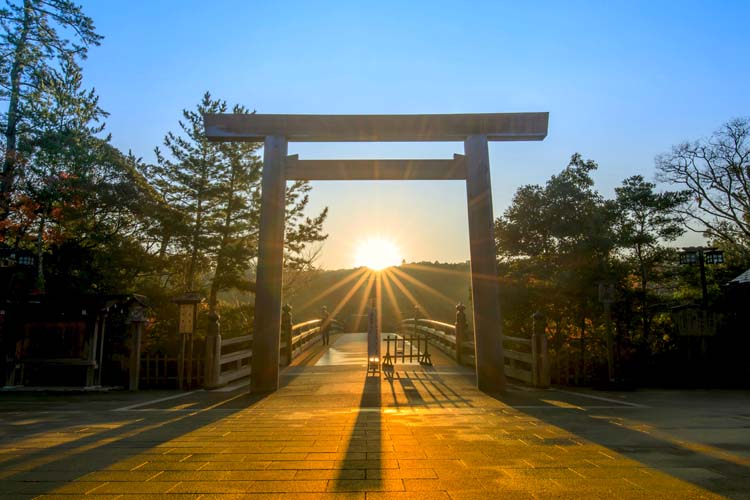
Ise Jingu Shrine in Mie Prefecture
Japanese Shinto consists of more than 100,000 shrines in Japan, led by the Ise Jingu shrine, but some of these shrines do not belong to the influence of the Ise Jingu shrine and prioritise their own uniqueness.
One of the largest of these shrines, with a history comparable to that of Ise Jingu, is Izumo Taisha in Shimane Prefecture.
And here we hope you remember our previous article.
It is. Mystery of the fallen God – part 1 (& part 2).
Despite being hated as a tyrannical god and banished from the heavens, the strange god Susanoo finally settled in the Land of Izumo, where he was portrayed as a hero who saved the weak and downtrodden once he landed on earth.
The Izumo Taisha shrine is dedicated to the sixth grandson of Susanoo, Okuninushi.
The relationship between Susanoo, Okuninushi and the central government of the time, the Yamato Kingdom, is described in the above article. The Izumo Taisha Shrine still retains its majestic appearance today, with many mysteries sealed away in the depths of history.(* Taisha = Grand Shrine)
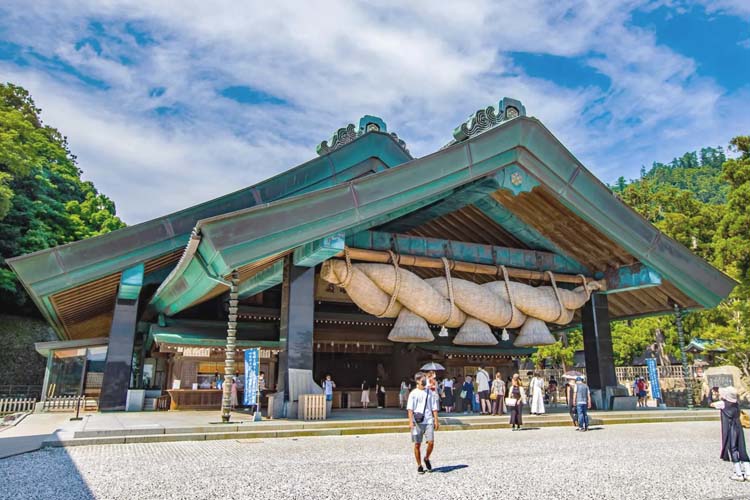
Izumo Taisha Shrine in Shimane Prefecture
Today I will introduce you to a slightly darker folk tale from the Izumo region…
『Minenge’s Night』
On the evening of the fourteenth day of August each year…
In the Village of Taisha, a secretive ritual known as “Minenge-san” was observed.
On that day, every household in the village would finish their daily tasks early, everyone would stay indoors with doors shut, and by the time the sun set, no one would venture outside.
That was because of a legend: on that very evening, the Great Deity of Izumo rode through the village roads atop a ghostly steed,
and should one accidentally encounter the procession, one would lose one’s life in the blink of an eye…
The villagers had observed this legend since time immemorial, and from that evening until the following morning, they did not set foot outside their homes…
However, in every age there are those with twisted dispositions…
「That’s utter nonsense! Everyone’s getting scared over some silly tale!」
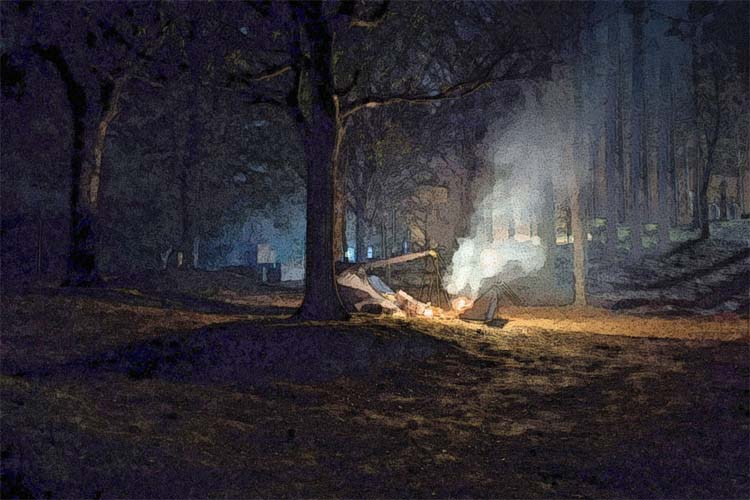
Ignoring those around him who tried to stop him, the man left his house as dusk was falling.
He made his way to the large tree at the end of the street, sat down beneath it, and waited for night to deepen.
The sun had sunk beyond the mountains, and the surroundings were enveloped in the deep darkness of night.
The village houses had already shut their doors tight, and there was no sign of human presence whatsoever.
Feeling a touch bored, the man let out a small yawn. At that moment,
two lights flickered into life far down the street.
What could those lights be? The man wondered, as they gradually drew nearer.
Staring intently, he saw the lights came from a tall, stretched lantern. Behind it rode a deity upon a great black horse, accompanied by several attendants on either side.
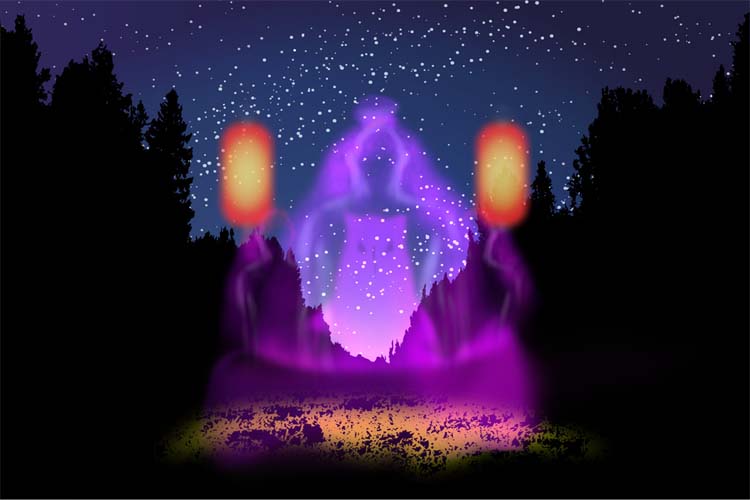
(Good heavens! Was that story true after all !?)
The man regretted his own foolishness. Though his heart yearned to flee at once, his legs had gone to jelly and he could not move.
While he hesitated, the god finally spotted him…
‘What is that…?’
The god asked his attendant in a quiet, solemn voice.
The attendant was startled by this unexpected turn of events.
To answer directly would have defiled the deity’s procession. Moreover, this man would have lost his life…
So, showing good sense, he replied thus:
‘Ah… that is a dog.’
The deity pondered for a while… but eventually
‘I see,’ was all he said before departing the scene.
The next morning, what the villagers saw was a dog wearing the man’s sash…
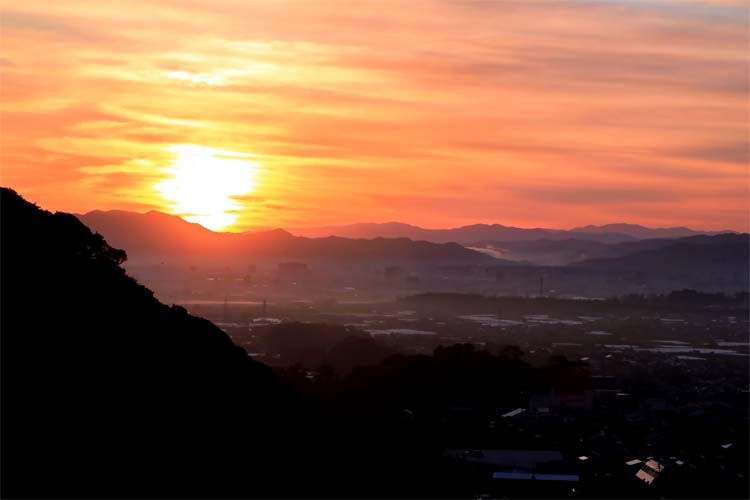
A morning scene in the Izumo region of Shimane Prefecture.
Izumo Taisha Shrine, boasting one of Japan’s most distinguished histories and largest scales… and shrouded in mystery.
A peculiar ritual known as the “Minige Ceremony” is said to be performed at this shrine in the early hours of 14th August.
As you might surmise, the word ‘Minige’ likely became the name of the deity ‘Mr. Minenge’ through dialectal change. Here, “Minige” derives from ‘Mi=身= body’ + ‘Nige=逃げ= escape = to flee or hide’. As this story explains, it signifies ‘hiding one’s body so as not to be found by the deity’.
In short, it is a sacred rite conducted solely by Shinto priests in an environment completely isolated from the general populace.
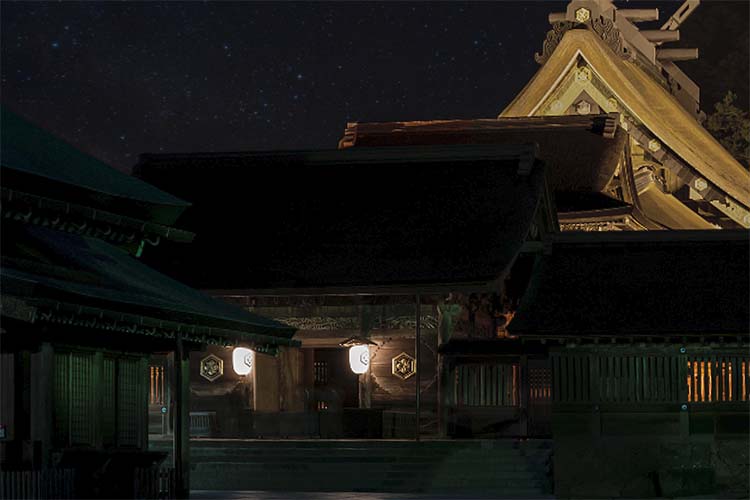
Conducted out of public view, it rarely becomes a topic of discussion. Television coverage is, of course, out of the question.
Consequently, opportunities for it to be spotlighted are few, and the majority of Japanese people remain unaware of this ritual. Even among residents of Shimane Prefecture, only a minority know of its existence.
The anticipated ritual is likely the “Shinkōsai”.
*Shinkōsai = A procession of the deity of the respective shrine, held once a year at many shrines across Japan.
However, the fact that it is conducted at around 1:00 AM by a select few, with almost no details made public, only adds to the mystery surrounding this ritual.
In our modern, time-free society, the streets bustle on relentlessly, whether it be day or night.
Though you’re unlikely to be transformed into a dog for being out late, we humans are fundamentally part of nature. Perhaps it would be best to live as much as possible in harmony with the natural flow of morning, day, and evening.