The ‘spoken language’ is both a tool and an act necessary for communicating one’s thoughts to others.
Conversation is about communication, so the ‘spoken language’ must be reasonable and accurate.

However, words used in normal conversation often contain words that have departed from their original meaning or have been misused.
This is probably not really the case, but our shifting selves and changing values probably have an impact on our language as well. This is why it is said that ‘Language is a living thing’.
Nevertheless, too severe misuse of language can sometimes be detrimental to communication…
There is a Japanese term ‘Uso’.
It is not “U, S, O”. It is “uso”.

The word means “lie”.
Naturally, lying is an act to be avoided in human relationships, and the word ‘lie’ itself does not give a good impression.

Lying, which can have a seriously negative impact on trust relationships.
It is not a good word and should not appear too often in everyday conversation…
However, the word ‘Uso’ can occur frequently in everyday conversation in Japan.
「Yesterday, I went out to Ginza for fun and happened to see Hikaru Utada. (^o^)」 *Utada Hikaru = famous singer.
「Uso!? (@o@!) What kind of fashion was Hikaru in?」
This is how it is used.
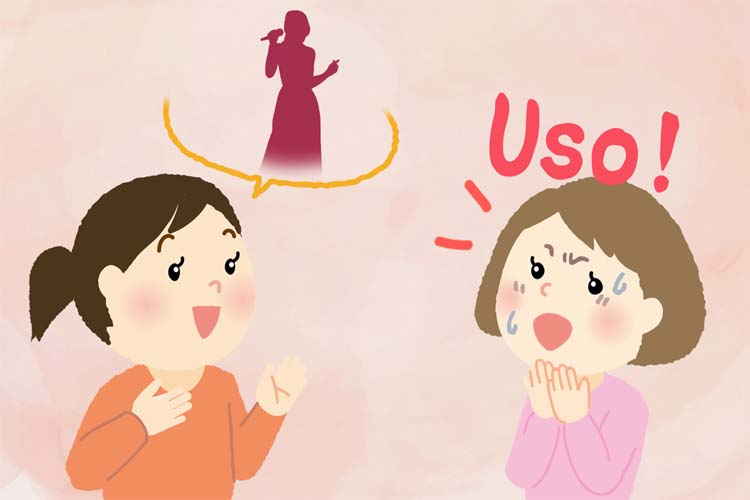
As you, the intelligent one, will understand, in this case “Uso! = lie!” does not mean that you assume that the other person is lying. It means that you are surprised by a topic that you don’t immediately believe.
You can put it another way: ‘Uso! It’s true! It’s so amazing I can’t believe it right away!” which is like a shortened exclamation.
If you were looking for the closest equivalent in English “Wow!“?
However, even in Japan, it is not good manners to use the word “Uso!” during a conversation. in conversation is not considered good manners. It should be avoided in professional and proper conversation.
It is more likely to be used in casual conversation between chatty young women. is often used in casual conversation between chatty young women. Men also use it, but it tends to be seen as frivolous.
Furthermore, to people abroad who are unfamiliar with Japanese language and conversation situations, this “Uso!” should be avoided at all costs.
Instead of “Wow!”, it can cause a lot of trouble with foreigners who may take it as an insult that you are a liar! can cause a lot of trouble with a foreigner who may take it as an insult.

For non-Japanese readers of this article.
If you encounter the word “Uso! in Japan, do not be surprised or offended, but first try to understand the situation.
Unless the situation is very hostile, “Uso! is simply an Unconsidered exclamations, unless the situation is very hostile.
Uso!” has been used extensively in the last 40-50 years. Even in Japan, the frequent use of “Uso! has long been questioned in Japan as well, as it is basically not good language. This is because it is basically not a good use of the word.
However, the fact that it continues to be used even though its original meaning has been bent is a result of ‘Language is a living thing’, isn’t it?
These misunderstandings and problems caused by misuse of language may not only occur between Japan and the rest of the world.
When we are involved in the culture and language of another country, both the speaker and the listener need to be prepared to give it due consideration…