
Three world-famous fairy tales include the Grimm’s Fairy Tales, Andersen’s Fairy Tales and Aesop’s Fairy Tales.
These three fairy tales are great works loved and retold all over the world, but only Aesop’s Fables have a very special situation.
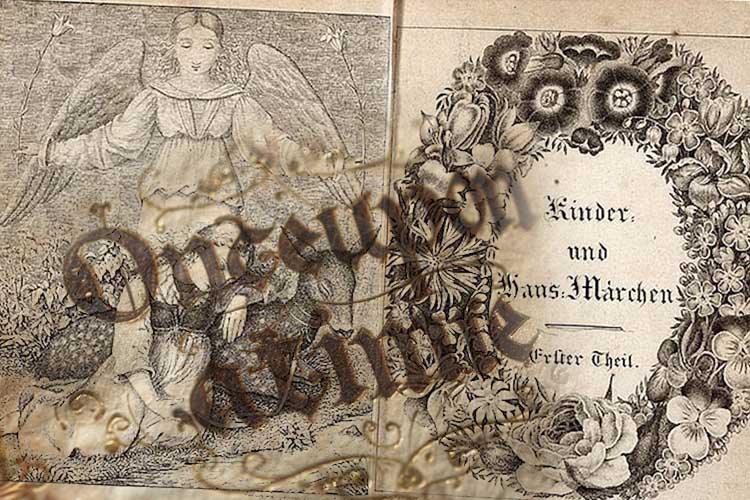
The Grimm Fairy Tales were written in the 19th century by the German brothers Jacob and Wilhelm Grimm. The Andersen Fairy Tales are a group of fairy tales written in the 19th century by Hans Andersen, also a Dane. Both were written some 200 years ago and are, of course, based on clear facts.
In contrast, Aesop’s Fairy Tales are a group of fables said to have been established around the 6th century BC and were told by a man named Aesop, although this has not been clearly verified.
While it is true that the works of Grimm and Andersen are influenced by folklore, it is fair to say that the body of work attributed to Aesop is a rich reflection of folklore from an older age.
One such Grimm’s fairy tale is called The Honest Woodcutter or Mercury & the Woodman.
A woodcutter drops his axe in the river.
A goddess appears and picks up the axe from the river.
To the golden axe offered by the goddess, the woodcutter replies that it is not his, and to the next silver axe offered, he honestly replies that it is not his either.
To the old iron axe presented a third time, the woodcutter replied for the first time, “That is mine”.
Impressed by his honesty, the goddess gave all three axes to the woodcutter…
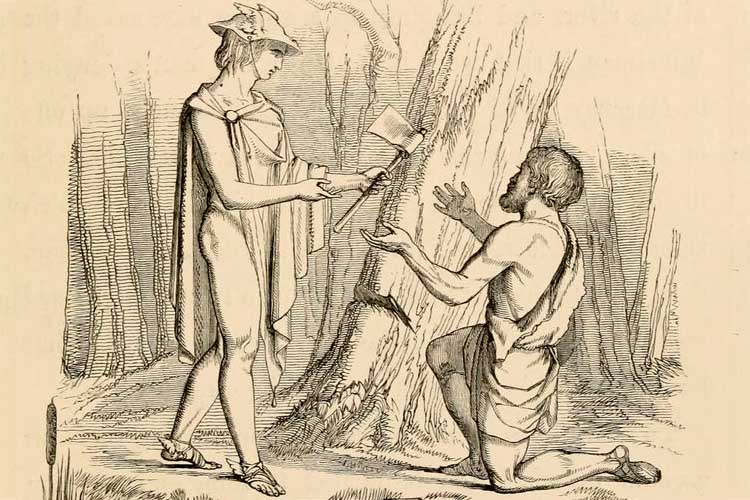
This story, which teaches that honesty is an important asset for people, is well known in Japan under the titles The Golden Axe and The Woodcutter and the Goddess.
In the original mythology, the deity is Hermes or Mercury, which gives a strong impression of a male deity, but in Japan, the impression of a goddess appearing from a pond with an axe is almost firmly established.
The story is easy to understand and has a strong impact, so it is often featured in manga and anime.
Folklore similar to this story seems to be found all over the world, as evidenced by the fact that there have been original versions of this story since BC.
Today we send you a folk tale about a pond and a woodcutter, which existed in Japan before Aesop’s Fables were handed down.
However, this story is a bit horror story…
「The female spider at Jōren Waterfall」
Once upon a time, a man called Yoichi from Yugashima was on his way home from an errand
and came to the side of Joren Falls and sat down on a stump to rest.
When he finished his rest and was about to start walking, he suddenly felt a strange weight.
When he looked down at his feet, he saw that there were several layers of spider threads wrapped around Yoichi’s legs before he knew it.
Feeling unspeakable anxiety, Yoichi removed the threads and rewrapped them around the stump where he had been sitting, and tried to leave.

Immediately afterwards, however, the stump tilted with a cracking sound, was eventually pulled out of the ground and finally sucked into the waterfall basin.
Yoichi, who could not stop shaking as he witnessed the horrific event, heard a woman’s voice from over the spray of the waterfall basin.
‘You must not tell anyone what you have seen here today…’
Yoichi felt the divinity in her voice and kept his word, never telling others or his family about it.
Within a few years, he became the most powerful farmer in the area.
He designated the area around the waterfall as a sacred area and forbade the felling of trees there.
He lived a peaceful life.
However, decades later, a woodcutter visiting the forest ignored this legend and attempted to cut down a tree in the forest.
The woodcutter swung his axe down on a thick trunk. However, his hand slipped and the axe fell into the waterfall basin.
The woodcutter jumped into the water and tried to find his axe.
Then a woman appeared in front of the woodcutter, enveloped in a dim light.

She said: “I will give you back the axe. But from now on you must not cut down any trees in this forest. And you must not tell anyone about what you saw here today…’
With that, the woman disappeared again, as if drowned out.
The lumberjack’s axe was lying on the roadside…
The woodcutter was surprised by the unexpected event and fled the scene.
For a while, the woodcutter stayed quiet and did not tell anyone about this.
However, perhaps tired of the stress of keeping silent, or perhaps drunken one night at a drinking party, he finally told others about what had happened in the waterfall forest.
As soon as he did so, the landscape around him darkened and black clouds began to boil over, followed by the loudest thunderclap I’ve ever heard.
The thunder was so loud that everyone at the feast was stunned.
After a while, when they finally regained their composure, someone noticed.
Kikori had disappeared.
A few days later, the woodcutter was found dead in a waterfall…
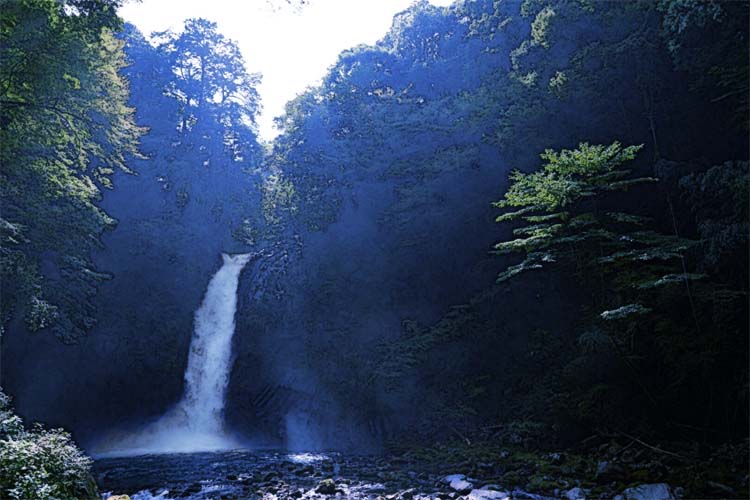
The woman in this tradition is thought to be the ‘Lord of the Waterfalls’ and at the same time a spirit with the character of a female spider.
Spiders are often associated with ‘weaving’ because of their ability to manipulate threads, and the concept of weaving → women’s work → goddess = spider god (spector) may have been born.
In Greek mythology, there is also a monster called ‘Arachne,’ who was originally a skilled weaver. She competed with Athena in a weaving contest and was transformed into a spider.
In Japanese folklore, water and women are said to be closely connected. Water” is the source of “life”, which gives birth to everything, but at the same time it is constantly shaking and shapeless, and its calmness and single-mindedness, which sometimes tries to overcome any obstacle to achieve its desire, transcends the East and the West. It may be a passion unique to the goddess.
Those waterfall pools and ponds were sometimes named ‘weaving ponds’ and so on.

浄蓮の滝 / Joren Falls, the setting of this story, is a real scenic spot deep in the mountains of Izu City, Shizuoka Prefecture….